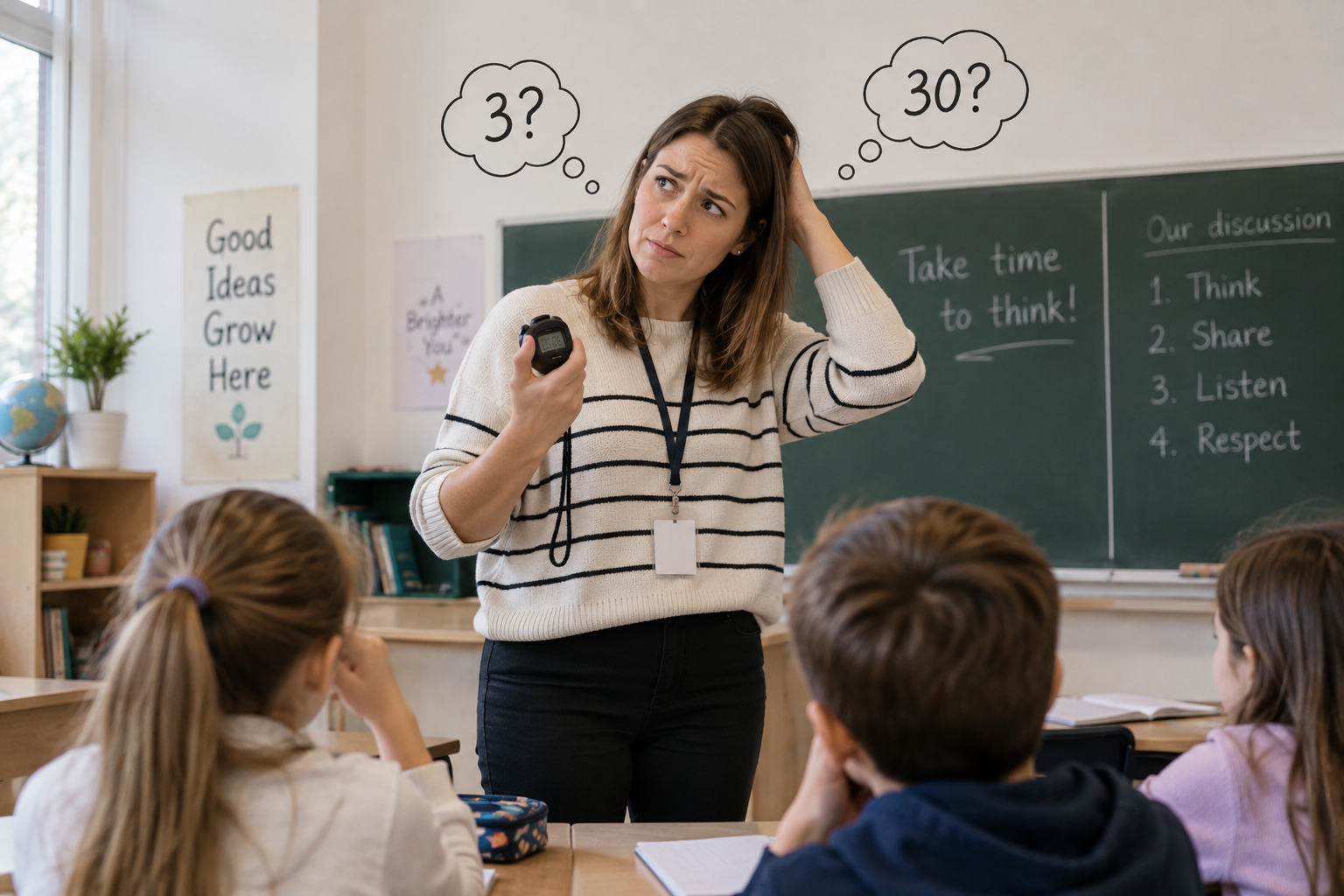

Three seconds is the floor the research gives you, and most teachers never reach it — the average pause after a question is under one second. The Dutch standard work on effective teaching puts the figure closer to thirty. Both numbers are right. They describe different kinds of questions.
Silence after a question feels like wasted time, but it is the only phase where everyone is working at once. The moment the first hand goes up, the rest of the room stops thinking.
Four numbers that don't agree
Anyone looking for a figure runs into four different answers.
Source | Recommended wait time |
|---|---|
Rowe (1986), wait time research | at least 3 seconds |
Dutch practitioner blogs on questioning | 5 to 10 seconds |
Ebbens & Ettekoven, Effectief leren | around 30 seconds |
What actually happens in classrooms | under 1 second |
The spread isn't a disagreement. Those sources are measuring different things. Three seconds is how long it takes to retrieve something you already know. Thirty is how long it takes to find and phrase an answer that wasn't sitting ready. The variable isn't the student. It's the question.
If you only keep one number, keep three seconds — and note that even three means tripling what you do now.
What changes between one second and three
Mary Budd Rowe recorded hundreds of lessons in the 1970s and found that teachers waited less than a second after asking a question. Push that pause to three seconds or more and a cluster of things shifts at once.
In the students:
Answers get longer — a sentence with reasoning in it, not a single word. "I don't know" drops away — and so does the number of students who say nothing at all. More students answer unprompted, without being called on. Speculative thinking appears — phrasing like "maybe it's because…", which barely occurs at one second. Test scores rise, and they rise most for the students who normally stay out of it.
And in the teacher, which is the part nobody expects:
Fewer questions get asked, but better ones. Questioning becomes more flexible and the questions themselves move up a cognitive level. Waiting changes what gets asked, not just who answers. Tobin (1987) reviewed the evidence and found the effect is clearest precisely where a question demands more than recall.
Wait time 2, which almost nobody gives
Rowe described two pauses. The second one gets skipped almost every time.
Wait time 1 sits between your question and the first answer. Wait time 2 sits between a student finishing their answer and you responding to it. There too, the average teacher comes in under a second — usually with "yes, exactly", or with the next question.
That second silence does two things the first one can't. The speaker gets room to extend their own reasoning, which is often the most interesting part of the answer. And everyone else gets time to process what was said instead of merely hearing it. Ebbens and Ettekoven describe it as letting the answer land.
In practice: count to three before you say anything. It feels uncomfortably long. To the group, it isn't.
How much wait time each question needs
The table below is a working guide, derived from the sources above and meant to be adjusted to your own group. It is not a measured law.
Type of question | Wait time | Why |
|---|---|---|
Recall: "what year", "what is it called" | 3 sec | retrieving, not composing |
Understanding in own words: "what does this mean?" | 10–15 sec | phrasing is what takes the time here |
Multiple answers: "name as many as you can" | 20 sec | you want quantity, not the first idea |
An opinion with reasoning | 30 sec | position and argument are two steps |
A question students write about | 1–2 min | writing is thinking on paper |
There's a test hidden in that table. If you can answer your own question in under a second, it doesn't need wait time. It needs rewriting.
Why silence alone isn't enough
Wait time is necessary, but it doesn't distribute turns. After twenty seconds of silence the same three hands go up as before, just better prepared. The students who weren't participating genuinely used those twenty seconds — and they still don't get to speak.
Two conditions have to hold, and silence supplies neither: the pause has to be used rather than endured, and what follows it can't depend on who reacts fastest. Ebbens and Ettekoven point at the same pairing — no hands up, but a quick word with the person next to you first. The consultation is what makes a random turn feel safe.
Inside a structure, that pairing is built into the mechanics instead of something you police each lesson:
Taking Turns — twenty seconds of silence to come up with as many answers as possible, then the turn goes round the group, one answer each, with the right to say "pass".
Think, Write & Share — think, then write, then share; here the writing is the wait time.
Written Thoughts — everyone writes at once and in silence, so the whole group's thinking runs in parallel rather than in sequence.
Snowball — the silent phase comes first, and every later round builds on it.
Placemat — individual writing before a single word is exchanged.
What these share isn't the silence. It's the agreement about what happens after it.
How to hold the pause
Count in your head. A pause runs roughly three times longer for the person holding it than for the group. Without counting you will almost certainly cut it short.
Say in advance what's coming. "I'll ask the question, then it's twenty seconds of silence, then we go round." Announced silence stops being awkward.
Don't repeat the question. Rephrasing mid-pause resets the clock for everyone, and the students who had something forming lose it.
Don't look at one person. Moving closer to a student raises the pressure; a step back does the opposite.
Make the time visible. With a timer running it's no longer painful silence, it's a phase in progress — for you as much as for them.
Leave silence after the answer too. Wait time 2 costs three seconds and is the one people forget.
Common mistakes
Asking the question and immediately naming someone. Then one person thinks and everyone else is off the hook.
Giving wait time on a question with one right answer. Whoever knows it knows it in a second; whoever doesn't won't get there in thirty.
Filling the silence yourself with "take a moment" or "this isn't hard". Same interruption, softer wrapping.
Using the pause as a discipline tool in a group that has just gotten loud. Silence works here as a thinking phase, not a reprimand.
Giving every question the same time. Three seconds for an opinion is too short; thirty for a date is a punishment.
It works the same way in a meeting
With a team the effect is easier to see than in a classroom, because there are fewer people and whoever speaks first sets the frame for everyone after them. The second person is no longer responding to the question — they're responding to the first answer.
Twenty seconds of silence up front, with everyone writing down what they think, changes the composition of what lands on the table. It costs half a minute out of an hour.
Silence isn't lost time.
It's the only phase where everyone has the floor at once.
Sources
Rowe, M. B. (1986). Wait Time: Slowing Down May Be a Way of Speeding Up! Journal of Teacher Education, 37(1), 43–50.
Tobin, K. (1987). The Role of Wait Time in Higher Cognitive Level Learning. Review of Educational Research, 57(1), 69–95.
Ebbens, S. & Ettekoven, S. Effectief leren — basisboek (in Dutch).
Wij-leren.nl — Beurten geven in de klas (in Dutch).