

Two ideas in one name
Nobody asks me where the name LudensFlow comes from. Secretly I wish someone would, so let me just tell the story myself. The answer has two parts, and both have everything to do with how I look at teaching.
Ludens: Huizinga
In the Netherlands, Johan Huizinga rarely needs an introduction. His Homo Ludens (1938) is about the play element of culture. According to Huizinga, law, science, poetry and manners all emerge in the form of a game: with rules, roles, a marked-off playing field and a clear beginning and end.
When I read the book twenty years ago as a student of cultural studies, what struck me most was how serious play is in his account. A game has strict rules, and whoever ignores them breaks it. Inside the lines of the playing field different agreements hold than outside — and those lines are precisely what makes the game possible.
I read that book in Ukraine, far from any Dutch classroom. Twenty years later I ended up in the Netherlands, at a school being built from the ground up by a team, where almost nothing was self-evident yet. That is where those old thoughts started shifting again, and they now fall into place differently than they did back then.
Why this is about the classroom
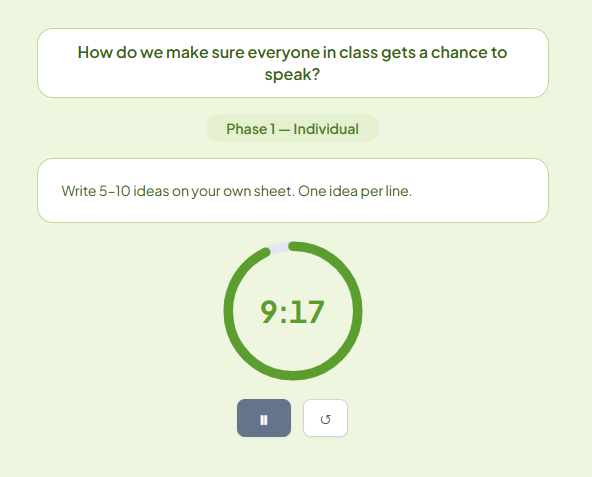
A good cooperative learning structure works the same way. You agree on a boundary of four minutes, you assign roles so that someone takes notes, someone watches the time and someone will summarise afterwards, and you fix a sequence in which everyone first thinks alone before anyone talks.
Inside that marked-off space something happens that rarely succeeds in an ordinary whole-class discussion. The student who normally stays silent does say something, because in this form speaking is simply part of the task and carries no personal risk.
Play, in this sense, means a bounded space with its own rules in which students dare to do things that are harder outside it. Quiz formats, points and competition are not, to my mind, an obvious part of that.
The rules belong to everyone in the room
Huizinga pays a lot of attention to what happens when someone violates the rules. The cheat pretends to play by them and is therefore tolerated for quite a while. The spoilsport denies the game itself and disappears from the group, because with him the whole agreement collapses. Huizinga also describes how a play community closes itself off from the outside world, with its own signs and its own secrets known only to the initiated.
In a classroom there is another layer underneath. Some students know the unwritten rules of school from home: when to raise your hand, how to enter a conversation, which question counts as a smart question. Other students don't know those codes — and that certainly goes for students who have only recently arrived in the country. As long as those rules stay unwritten, the first group has a head start that has nothing to do with the subject matter.
That is why every structure shows its full instructions on the class screen: what happens, in what order, how long it takes and who has which role. From that moment the form also exists outside the teacher's head. Everyone in the room can see whether things are going as agreed, can call out someone who runs over their time, and can announce the next step.
The rules become the shared property of the people in the room — and that changes who gets to steer the conversation.
Bourdieu: the code school demands but never teaches
Pierre Bourdieu was on my reading list in those same years, and he described this mechanism most sharply. His term for it is cultural capital: the way of speaking, the ease of taking the floor, the feel for what is appropriate in this environment. Children bring it from home without anyone ever having explained it to them. Together with Jean-Claude Passeron, Bourdieu showed in La Reproduction what education does with it. School demands from all students a code it does not itself teach, and then rewards the students who already possessed it.
In Dutch education there is one rule where this shows most clearly: just ask if you don't understand something. Teachers mean it sincerely and say it with the best of intentions. The rule merely presupposes rather a lot. That you know that you don't understand. That you have words for what exactly is missing. That you find it normal to interrupt the lesson for it. And that a question counts here as a sign of engagement and not as a confession.
I see what this does to students who move from newcomer classes — where students new to the country first learn the language — into regular education. Colleagues report that these students never ask anything, and the conclusion suggests itself: they must be fine, or the motivation is missing. So the extra explanation never reaches precisely the group that would benefit from it most. I have drawn that conclusion myself too; from the inside there is little to see. Meanwhile the student who takes the floor fluently counts as engaged and bright — and so a difference in code quietly turns into something that looks like talent.
The most uncomfortable part comes after that. The local students hardly ever ask anything either. With them the problem sits one layer deeper: they usually know which steps to take, without seeing why those steps hang together. That difference between functional and structural understanding cannot be read off a face, and the student doesn't see it either. Nobody can estimate how much they don't understand as long as they have never had to explain it.
"Any questions?" — I still ask it myself, and the silence that follows says almost nothing. Saying that everything is clear is quickly done. Retelling it in your own words to someone who doesn't know it yet is work of a different order, and that is where what is missing comes to the surface.
Every unwritten rule in a lesson is a place where this mechanism can operate:
who gets to start;
whether interrupting is normal here;
how long you hold the floor;
whether you are allowed to say something you are not yet sure of.
As long as such things remain implicit, the class answers them from what was learned at home.
Foucault: an institution that repeats itself
Bourdieu shows which students have the advantage. Michel Foucault describes the machinery around it. In Discipline and Punish he places the school alongside the barracks, the hospital and the prison: places where people are distributed across a space, ordered in time and continuously assessed. The timetable, the rows of desks, the test and the report card measure knowledge and at the same time determine what counts as knowledge and who may speak about it.
His sharpest observation is that power in such institutions is rarely visible as coercion. It sits in what has become self-evident. A lesson in which the teacher asks and the students answer feels to everyone present like the normal course of things, and so that order is confirmed anew every day without anyone taking a decision about it. The school passes its own way of speaking on to the next generation, which in turn comes to find it normal.
That is also where the opening lies. Foucault expected little from reform from above and looked instead at the places where the order is actually carried out. A classroom is exactly such a place. A student who experiences for three years that everyone gets to speak because the form arranges it, that a good question can also come from a classmate and that the teacher facilitates the conversation, takes that along as the measure of what is normal. That is where the small revolution sits: in what a group of students has experienced as ordinary for years.
What an explicit structure changes
I would be making it too pretty if I claimed that a good structure cancels this advantage. What does happen is that for that half hour the code lies on the table instead of in the upbringing of part of the class. Everyone gets the same turn, the same time and the same question. Whoever knows the habits of the school system less well from home doesn't have to spend those minutes guessing what is actually expected here, and keeps them for the subject itself.
More important is what the form enforces. In a structure it does not depend on the student whether they report their confusion, because they have to formulate either way. They explain it to their neighbour, they summarise for their group of four, they write down in one sentence what the group found. That is where what is missing becomes visible — and the first one to see it is the student themself.
Equity depends only to a limited extent on who dares to ask — and far more on whether the form makes everyone formulate.
The first is a trait of the student; the second is a design choice of the teacher. That is also why the teacher in this setup is a facilitator. They are not the only guardian of the rules of the game, because the rules are right there for everyone to see.
One nuance belongs here, and Foucault would make it himself. A structure does not remove power from the room. Whoever watches the time and whoever distributes the turns exercises power, even when the rules are on the board. The difference is that this power is then visible and changes hands, so that over the course of a year every student has sat on both sides of the table.
Flow: the movement within a lesson
I use the word flow in two senses, and both are built into the platform.
The first is the movement within a lesson. A structure like Snowball (1-2-4-All) has students think alone first, then confer in pairs, then in groups of four, and only at the end as a whole class. Ideas flow from individual to collective, every step builds on the previous one, and the lesson arrives somewhere.
The second meaning is the better-known one: being absorbed in what you do, when the challenge matches what you can handle. That state rarely arises by itself. A student who doesn't know what is expected of them stays busy with the question of what they are actually supposed to do, and never gets there. Structure is a precondition for it.
Playfulness and structure belong together
At first sight the two words lie far apart, while in practice they need each other. I think it is precisely in that combination that people make meaning, build knowledge, truly master something and treat each other well while it happens.
In Ukrainian, by the way, the word ludens sounds almost like люди — which means people. That is a coincidence, but it fits a platform where the structure is never a goal in itself. At the centre are the people in the room.
That is why the platform is called LudensFlow. Every structure on it is a bounded space with rules, roles and a time limit — and at the same time a route that leads somewhere.
Curious what such a bounded space looks like in practice? Six structures are free to try, no account needed; a free account makes it twelve — free forever. New to cooperative learning? Start with what these strategies are and how to use them in the classroom, or browse the full list of fifteen.