
You know the moment: you say "discuss it in groups" — and within thirty seconds two students are chatting, three are staring out the window, and one is sneaking a look at their phone.
Your class isn't lazy or unwilling.
"Discuss it" simply isn't an instruction.
It doesn't specify who starts, who listens, or when it ends. Cooperative learning structures fill exactly that gap. They are structured forms of collaborative learning in which every student actively participates. This produces active learning instead of passive listening.
They divide roles, turns and time, so participation becomes automatic. In this article you'll find 15 cooperative learning structures for collaborative learning. These activating structures help students engage actively with the material and turn an ordinary lesson into an interactive learning experience.
WHAT IS A COOPERATIVE LEARNING STRUCTURE?
New to cooperative learning?
First read what cooperative learning structures are and how to use them
Cooperative learning structures are structured forms of collaborative learning in which every student gets a clear role, turn and responsibility. This produces active learning: students don't just listen — they think, talk, explain, compare and reflect. The difference from "ordinary group work" lies in two principles:
equal participation (everyone gets a turn, not just the fastest talker), and
individual accountability (no one can hide behind the group).
Many of these structures were developed by Spencer Kagan and Elliot Aronson; the structures below are based on their work and are directly usable in a regular lesson.
Collaboration isn't a talent your class has.
It's a structure you design.
WHY DOES IT WORK?
Because the structure does the work. In a whole-class discussion, one student speaks at a time; in pairs, half the class speaks at once. Whoever knows their number might be called stays mentally engaged. Whoever has to explain the material to someone else processes it more deeply than someone who just listens. A timer also removes the "whose turn is it" debate from the lesson: the signal decides, not you. And the lesson becomes calmer, because everyone knows what's expected of them and when.
PAIR STRUCTURES
Every structure below stimulates active learning in its own way. Some emphasize collaboration, others reflection, explaining, or movement. This makes it easy to pick the structure that fits your learning goal.
1. Pair Coach
Group size: 2 ·
Time: 90 sec per task (default)
Thinking aloud, like programmers doing pair programming.
Step 1: A solves an exercise and verbalizes their thought process aloud.
Step 2: B follows along and coaches — redirecting without giving away the answer.
Step 3: switch roles for the next task.
Use an even number of tasks. Strong for math and languages: here the thought process matters more than the answer.
See more tips and try it out!
2. Read and Ask
Group size: 2 ·
Time: a few minutes per text passage
Reading aloud with a built-in comprehension check.
Step 1: A reads a passage aloud, B listens.
Step 2: B asks a content question about the text.
Step 3: if the answer is wrong, A points to the correct spot in the text. Then switch.
Ideal for language lessons and source material in content subjects.
View here
3. Flashcards
Group size: 2
Time: 10–15 min, depending on the set
Active repetition with immediate feedback.
Step 1: students come up with questions and write them on cards — question on the front, answer on the back.
Step 2: in pairs, they take turns quizzing each other.
Step 3: swap sets between pairs for a new round.
Perfect right before a test: vocabulary, formulas, concepts.
See Flashcards
SMALL GROUP STRUCTURES
4. Taking Turns
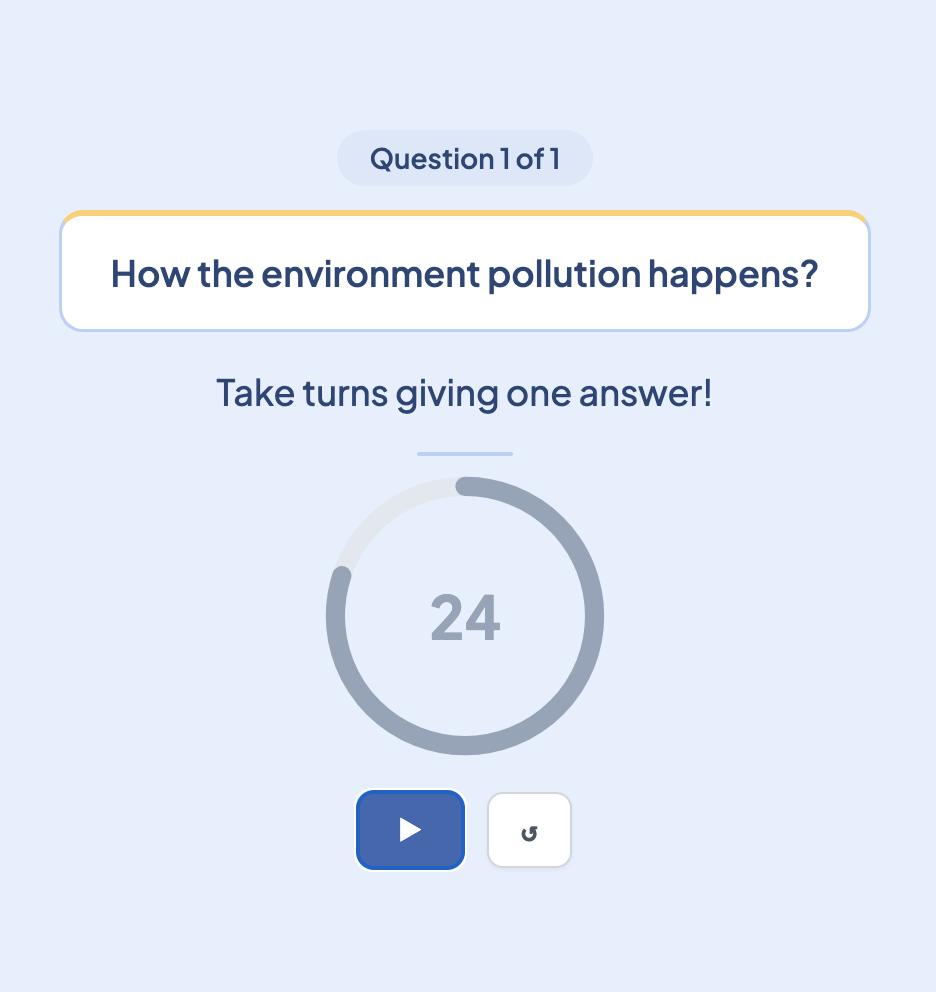
Group size: 2–4 ·
Time: 45 sec per answer (default)
The simplest structure for equal participation.
Step 1: pose an open question or task.
Step 2: students give one answer in turn — no one skips, no one dominates.
Step 3: repeat with a new question or a new round on the same question. Great as a warm-up or review: "name as many as you can...".
Based on the principle of equal participation.
See Taking Turns (a.c.a. Round Robin)
5. On Time
Group size: 4 (flexible 2–6) ·
Time: 30 sec speaking time per student (default)
Everyone gets equal speaking time — the timer enforces it.
Step 1: decide who is A, B, C and D.
Step 2: A speaks for 30 seconds on the topic; the others listen.
Step 3: then B, C and D — same time, same attention.
Teaches concise formulation and patient listening.
See On Time (a.c.a. Timed Talk)
6. Numbered Minds
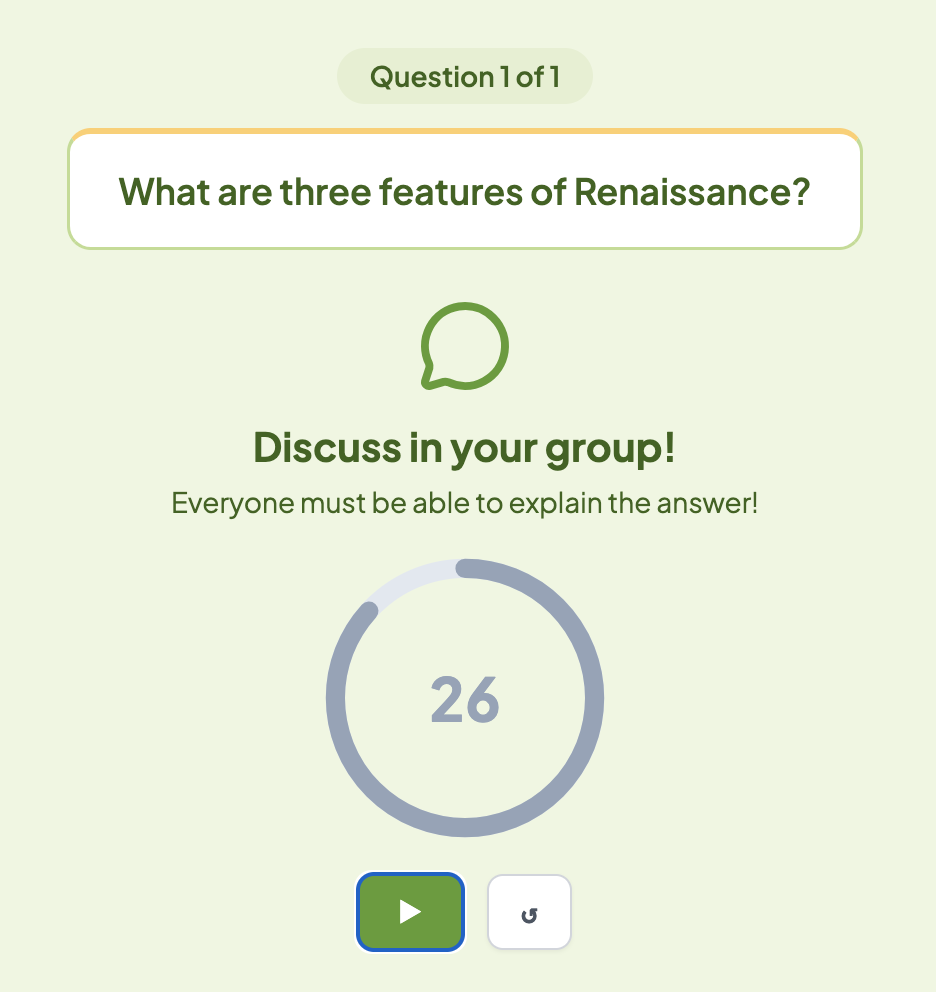
Group size: 2–6, default 4 ·
Time: 60 sec discussion per question (default)
No one knows which number will be called on next.
Step 1: each student in the group gets a number.
Step 2: pose an open question; everyone writes individually first, then the group discusses together.
Step 3: call a random number — that student explains the group's answer.
The real remedy for free-riding: everyone must be ready to answer. Based on a structure by Spencer Kagan.
See Numbered Minds (a.c.a. Numbered Heads)
7. Think, Write & Share
Group size: 2–6, default 4 ·
Time: 60 sec individual + 90 sec comparing (default)
Think for yourself first, then as a group.
Step 1: everyone individually writes down as many ideas as possible.
Step 2: the group compares lists and adds to each other's ideas.
Step 3: one student shares the combined list with the class.
Strong for activating prior knowledge and brainstorming.
See Think, Write and Share (a.c.a. Team Jump-In and Share)
8. Interview in Three Rounds
Group size: 4 (interviews in pairs) ·
Time: 60 sec per interview + 90 sec sharing (default)
Listening in order to retell.
Step 1: in a group of four, A interviews B while C interviews D, simultaneously.
Step 2: switch roles — the interviewee becomes the interviewer.
Step 3: each member summarizes what their partner said and shares it with the group of four.
Great for both getting to know each other and for deeper engagement: you're heard through someone else's voice.
See Interview in Three Rounds (a.c.a. Three-Step Interview)
9. Shuffle & Pick
Group size: 4 ·
Time: 10–15 min, depending on the card set
Four roles, one deck of cards — everyone participates.
Step 1: A fans out the cards, B draws one and reads the question aloud.
Step 2: C answers the question.
Step 3: D checks the answer and coaches where needed.
Roles rotate every round. Repetition of concepts, formulas or facts in a tight rhythm.
See Shuffle & Pick (a.c.a. Shake and Take)
10. 1 Goes, 3 Stay
Group size: 4 ·
Time: 15–20 min including team work
Knowledge travels around the classroom — via one messenger.
Step 1: each team works on its own text or sub-task.
Step 2: one team member visits another group and gathers information there.
Step 3: the messenger returns and shares the findings with their own team.
Strong when teams each study a different aspect of a topic.
See 1 Goes, 3 Stay (a.c.a. 1 Stray, 3 Stay)
11. Jigsaw
Group size: 4 ·
Time: allow 30–45 min — the most complete structure on this list
Every student becomes an expert — and the group needs everyone.
Step 1: divide the material into four parts; each team member gets one.
Step 2: experts with the same part meet in expert groups and dig deeper.
Step 3: everyone returns to their home group and teaches their part to the rest.
The classic by Elliot Aronson (1971): no one can do it without the others.
See Jigsaw
12. Placemat
Group size: 3–4 per sheet ·
Time: 3 min writing + 2 min sharing + 2 min consensus (default)
Individual thinking and a group result on a single sheet of paper.
Step 1: each student writes their answer in their own section of an A3 sheet.
Step 2: the group shares answers with each other.
Step 3: together they formulate a joint conclusion in the middle.
Every voice becomes literally visible — strong for dilemmas and interpretations.
See Placemat
WHOLE-CLASS STRUCTURES
13. Movement Quiz
Group size: whole class ·
Time: 10–15 min
Movement plus repetition — the energizer with content.
Step 1: each student gets a card with a question and its answer.
Step 2: walk around the room, find a partner, quiz each other, and give feedback.
Step 3: swap cards and find a new partner.
Based on a structure by Spencer Kagan.
Tip: use the card generator to print the cards as a ready-made PDF.
See Movement Quiz (a.c.a. Quiz Mixer)
14. Inner & Outer Circle
Group size: whole class (even number) ·
Time: 2–3 min per conversation, multiple rounds
Many conversation partners in a short time.
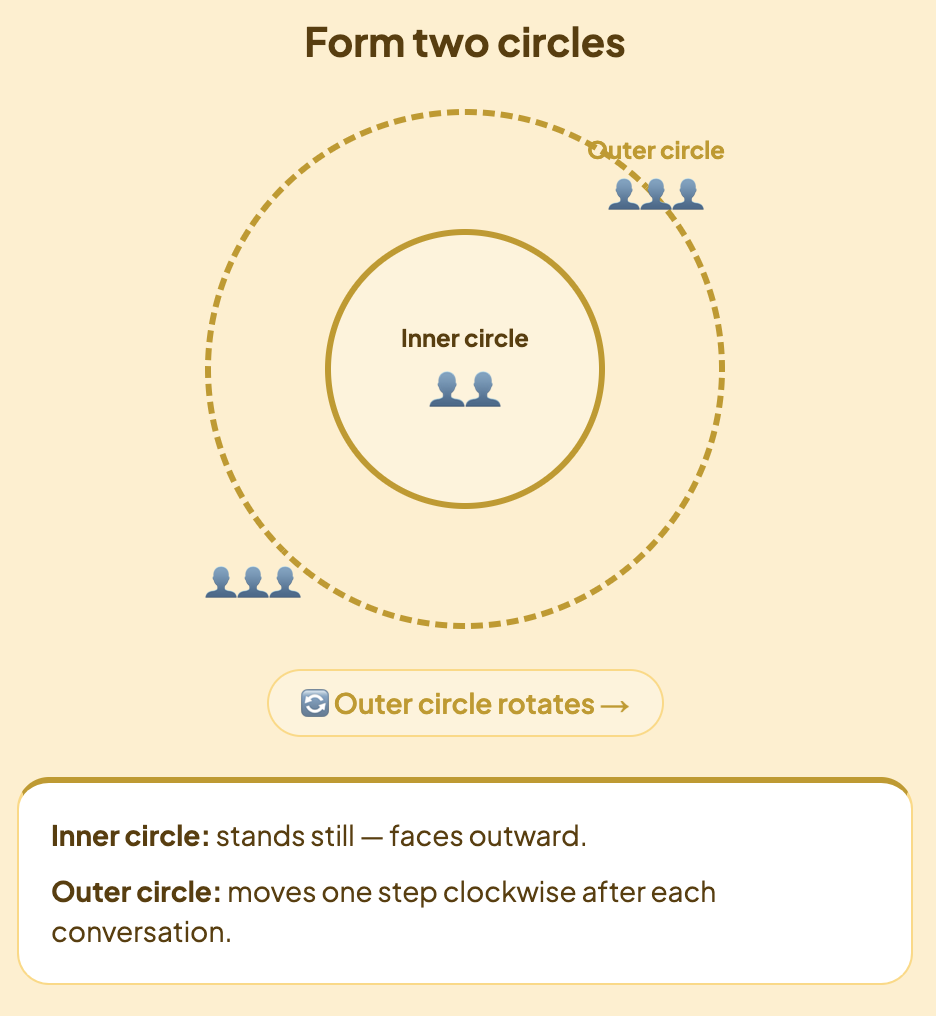
Step 1: form two circles facing each other — every student has a partner.
Step 2: brief conversation on the question shown on screen.
Step 3: after the signal, the outer circle shifts one spot — new partner, new round.
Strong for exchanging opinions, speaking skills and getting acquainted.
See Inner & Outer Circle (a.c.a.Inside-Outside Circle)
15. Snowball (1-2-4-All)
Group size: whole class ·
Time: 15–20 min
From silent reflection to shared insight — step by step.
Step 1: everyone first reflects individually on the question.
Step 2: compare in pairs and build on each other's ideas.
Step 3: merge two pairs into a group of four; each group of four then shares its best idea with the whole class.
Every voice is heard before the whole-class discussion begins.
See Snowball.
HOW TO CHOOSE — BY GOAL, BUT ALSO BY THE CLASS THAT WALKS IN
Not every lesson calls for the same instructional structure. Sometimes you want to activate prior knowledge, sometimes you want to stimulate deeper collaborative learning, or let students process material independently. Which structure is best? That depends on what your lesson needs right now.
Choosing by goal is the first route.
Review before a test → Flashcards, Shake and Take, or Quiz Mixer.
Activating prior knowledge → Team Jump-In and Share or Snowball.
Deep processing → Jigsaw or Placemat.
Enforcing equal speaking time → Timed Talk or Round Robin.
But every teacher also knows the other scenario: you've prepared a great lesson — and then the class walks in. Seventh period, right after gym class, just before a break.
The group you planned for isn't the group that's sitting there.
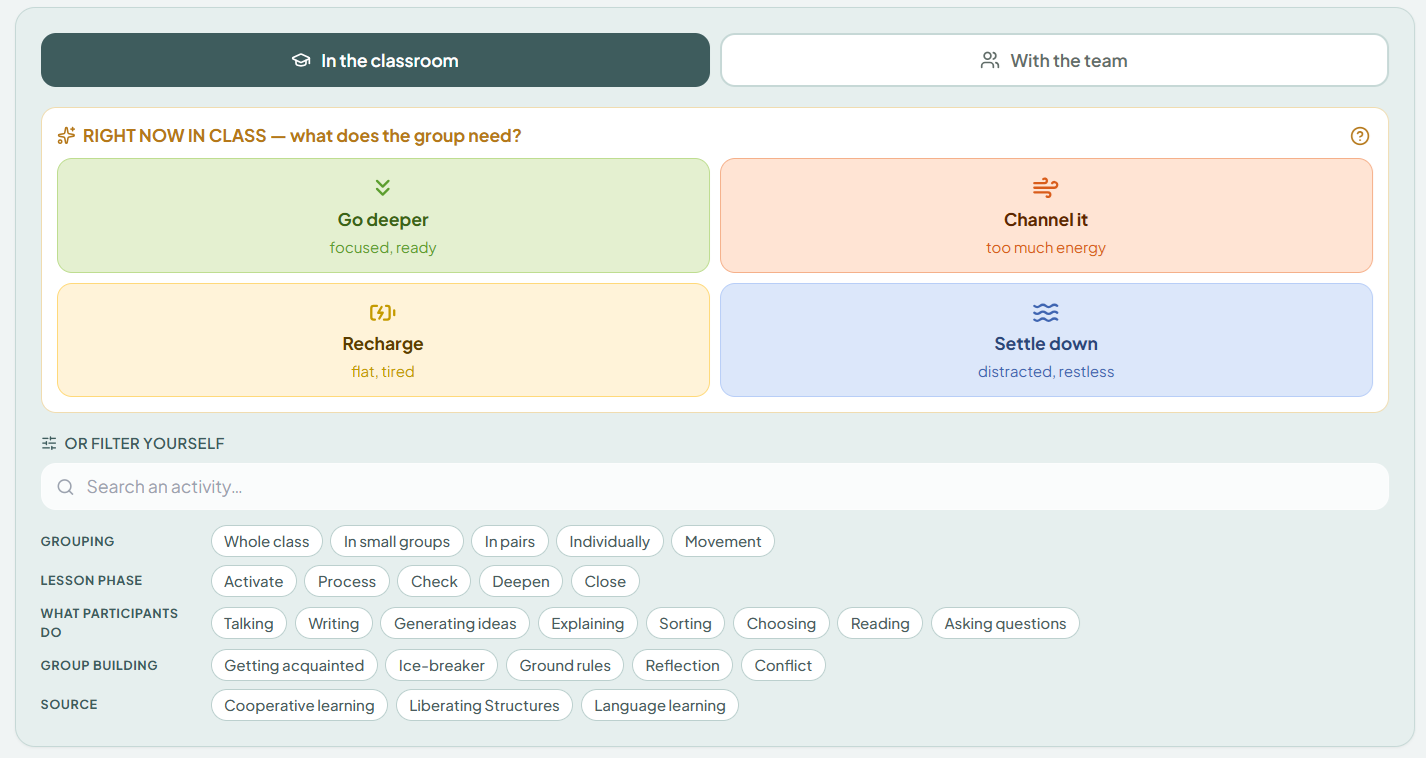
That's why in LudensFlow you can filter not only by social structure (pairs, groups, whole class), lesson phase, and the type of learning activity you want to organize. But also by what the group needs right now:
Go deeper — the class is focused and ready: now you can dig deeper, with Numbered Heads or Three-Step Interview.
Channel — too much energy: give that energy a structure, with Jigsaw or 1 Stray, 3 Stay. Recharge — flat and tired: bring back movement and pace, with Quiz Mixer or Inside-Outside Circle.
Settle down — distracted and restless: slow down and refocus, with Round Robin or Read and Ask.
This way you can prepare two scenarios in advance — one for the class you're hoping for, one for the class you get — or even switch mid-lesson.
Every structure on this list is ready to go as a scenario: you type in your questions, choose the group size and timing (the default values above are already set), and the class screen guides the lesson — phases, turns and timer included.
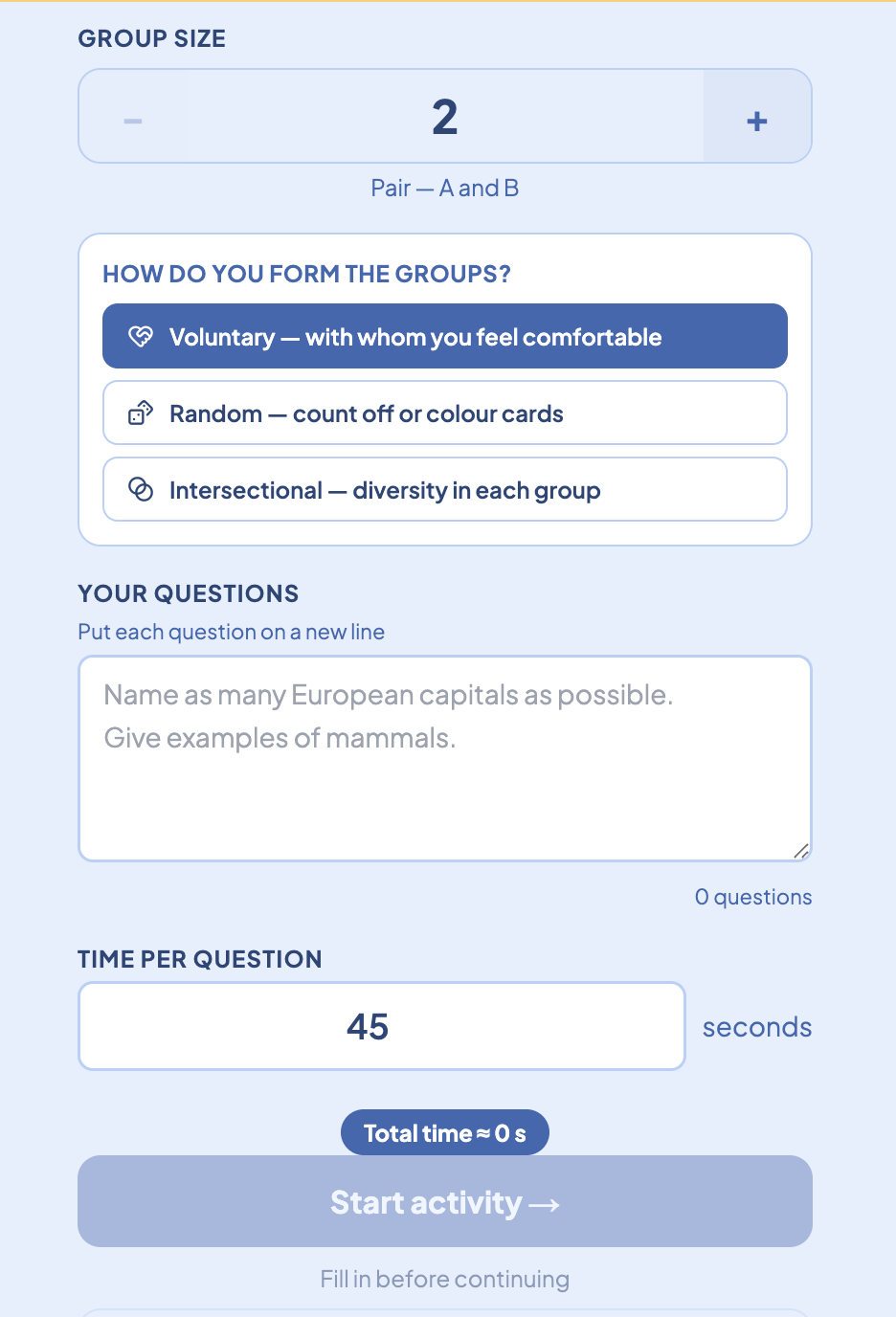
Five minutes of preparation, and the structure does the rest. No account needed to get started.
START WITH ONE STRUCTURE — AND MAKE IT A HABIT
Fifteen structures in one list doesn't mean you have to use all fifteen this school year.
A structure only really works once it has become routine — for you and for your students.
The first time you run Numbered Heads it takes explaining, questions, shuffling chairs. The third time, the class says "ah, numbers" and everyone is ready within a minute.
From that point on, the structure fades into the background and all attention goes to the content. So pick one structure and run it for a week — or a few weeks — in different lessons, with different questions.
Only once it runs on its own do you pick up the next one. Give yourself that repetition: building habits takes time, for teachers just as much as for students.
One well-ingrained structure per period delivers more than five that need to be explained again every time.
After that, make it a fixed rhythm: at least one activating structure every lesson, as much a given as the instructions or the homework.Whoever saves it for "if there's time left over" rarely gets to it. And one pitfall: don't ask. To "shall we work in groups?" a class will almost always say no — no is simply the easiest option, since you can just as easily not do independent work either.
So don't give them that choice. What does work, once your class knows a few structures: let them choose between two structures.
"Are we doing this with Numbered Heads or with Round Robin?" Then the conversation is about how they participate — not whether.
A structure only really works
once no one is thinking
about the structure anymore.
CONCLUSION
Cooperative learning structures turn "discuss it" into a real assignment: with a role, a turn and a timer for every student. Pick one structure from this list, run it a few times this week, and give yourself and your class time to get used to it. The rest of the list isn't going anywhere.