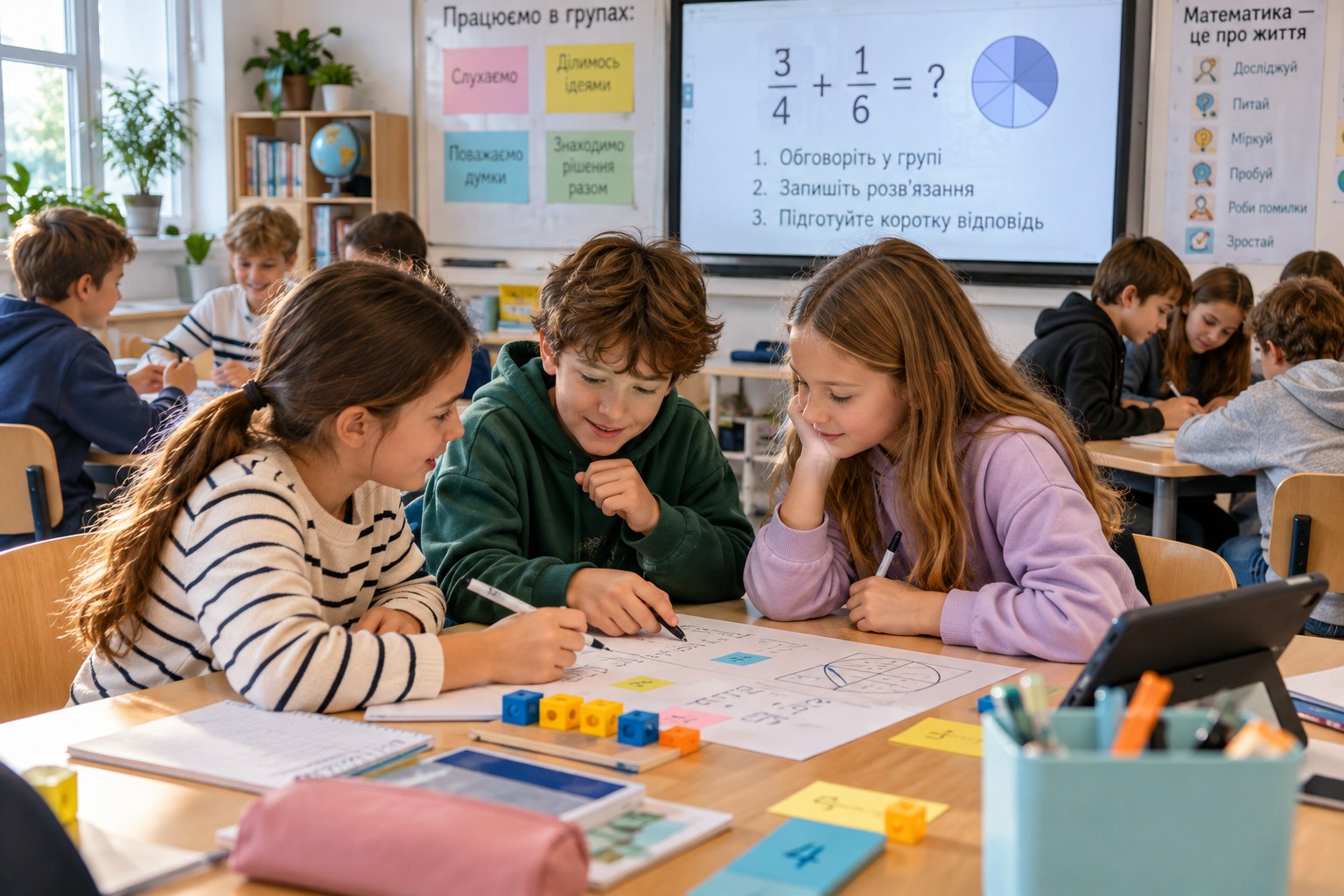

In a math lesson, cooperative learning works best at three moments: building fluency, practising problems with more than one step, and reviewing before a test. Below are seven structures grouped by those moments, each with example problems for grades 3–6 and for grade 7. At the end you will find three sets of eight cards you can drop straight into the card generator.
A worksheet is done alone, and a student who gets stuck stays stuck until the teacher comes by. In a structure, every problem has a second pair of eyes, and whoever explains it practises it twice.At a glance
Structure | Lesson moment | Grouping | Time |
|---|---|---|---|
Flashcards | fluency | pairs | 10–12 min |
Movement Quiz | fluency, vocabulary | whole class | 10–15 min |
Pair Coach | multi-step problems | pairs | 10–20 min |
Numbered Minds | explaining why | groups of 4 | 10–15 min |
Shuffle & Pick | practice with checking | groups of 4 | about 12 min |
Taking Turns | number sense, many answers | groups of 4 | 5–15 min |
Knowledge Quiz | review before a test | 2–4 teams | 5–10 min |
If you know the Kagan structures, you will recognise them: Flashcards is the Flashcard Game, Movement Quiz is Quiz-Quiz-Trade, Pair Coach is RallyCoach, Numbered Minds is Numbered Heads Together, Shuffle & Pick is Fan-N-Pick and Taking Turns is RoundRobin. The Knowledge Quiz is a team quiz on the board, not a Kagan structure. For all fifteen structures without a subject focus, see 15 cooperative learning structures for a lesson.
Fluency: times tables, numbers to 1,000, order of operations
Fluency is about speed and repetition. A structure adds two things: each student answers far more often than in whole-class questioning, and a wrong answer comes back on its own.
1. Flashcards
Pairs · 10 minutes · from grade 1
A reads a card, B answers. Correct: B keeps the card. Wrong: the card goes to the bottom of the pile and comes back later.
Grades 3–4: the 6 to 9 times tables and the matching division facts. Put a helper fact on the small line of the card: for 7 × 8, "7 × 7 + 7"; for 6 × 9, "6 × 10 − 6".
Grades 5–6: fractions, decimals and percentages that mean the same thing: ¼ = 0.25 = 25%.
Grade 7: negative numbers and powers: −7 + 12, −3 × −4, 2³ + 3².
Sending a miss to the bottom of the pile is the whole point in math. The facts a student does not know yet come round more often than the ones they already have. Keep the pile to twenty or thirty cards.
Printable cards, 32 per set: grades 3–4: times tables, to 1,000, fractions · grades 5–6: working with fractions, decimals, percentages · grade 7: negative numbers, powers, equations (PDF)
2. Movement Quiz
Whole class, 10–34 students · 10–15 minutes · from grade 3
Everyone holds one card. Find a partner, quiz each other, swap cards and find a new partner.
Grades 3–4: one problem per card, such as 63 ÷ 7 or 503 − 198.
Grades 5–6: converting between forms: "⅖ as a percentage", "0.75 as a fraction", "15% of 200".
Grade 7: order of operations and vocabulary: "Which comes first, × or +?", "What is 13 squared?"
Because cards change hands after every conversation, each student works through five or six different problems in ten minutes and checks as many classmates. You need at least as many cards as students.
Printable cards, 32 per set: grades 3–4: times tables, to 1,000, fractions · grades 5–6: working with fractions, decimals, percentages · grade 7: negative numbers, powers, equations (PDF)
Practice: problems with more than one step
Here the answer matters less than the approach. A one-step problem is too short to talk about. Choose problems with an intermediate step: a word problem, a ratio, an equation.
3. Pair Coach
Pairs · 10–20 minutes · from grade 3
One student solves aloud, the other watches and asks one question about the approach. Roles swap after each problem.
Grades 3–4: "Maya has 4 bags of 12 marbles and gives 15 away. How many does she have left?" (33)
Grades 5–6: "A class of 28 students is going on a trip by minibus. Each minibus seats 8. How many minibuses do they need?" (4, not 3.5)
Grade 7: "Solve: 3x − 4 = 2x + 7." (x = 11)
The minibus problem shows what coaching adds: the division is right, the answer is not. A coach who asks "can you book half a minibus?" is doing exactly what the structure is for. There is nothing to coach in a bare fact like 7 × 8. Use Flashcards for that.
Open ready-made: multi-step problems · grades 5–6 · ± 16 min →
4. Numbered Minds
Groups of 4 · 10–15 minutes · from grade 2
Everyone first writes their own answer, then the group agrees on one answer that any member can explain. Only then is a number drawn, and that student answers for the group.
This structure needs "why" questions. A problem with only a result is finished in ten seconds.
Grades 3–4: "Is 2 + 3 × 4 = 20? Explain."
Grades 5–6: "Why is 0.5 × 8 less than 8?" and "Two discounts of 10%: is that 20% off?"
Grade 7: "Why is −3 × −4 positive?"
The discount question shows why the discussion matters. A jacket at $80 costs $72 after 10% off, and $64.80 after another 10%. That is 19% off, not 20%, and the student who spots it now has to explain it well enough for whoever's number is drawn to repeat it.
Open ready-made: “why” questions · grades 5–6 · ± 19 min →
5. Shuffle & Pick
Groups of 4 · about 12 minutes · from grade 3
A fans the cards, B picks one and reads it, C answers, D turns the card over, checks and adds what was missing. Roles rotate every round.
Grades 3–4: numbers to 1,000 and simple fractions: "What is ½ of 36?"
Grades 5–6: ratios and percentages: "3 notebooks cost $4.50. How much do 7 cost?"
Grade 7: brackets and equations: "Expand: 3(x + 4)."
In math, the value lies in role D. Ask D not just to say "right" or "wrong" but to name the intermediate step written on the card. That is why every card in the sets below has a helper line. The structure is too early for grades 1–2: the checking role asks too much.
Printable cards, 32 per set: grades 3–4: times tables, to 1,000, fractions · grades 5–6: working with fractions, decimals, percentages · grade 7: negative numbers, powers, equations (PDF)
Review and retrieval
6. Taking Turns
Groups of 4 · 5–15 minutes · from kindergarten
Twenty seconds of silent thinking, then the turn goes round: one answer each, and "pass" is allowed.
Taking Turns does not work with problems that have a single answer. So turn the question around:
Grades 3–4: "Name problems whose answer is 24." (3 × 8, 30 − 6, 48 ÷ 2, 12 + 12…)
Grades 5–6: "Name fractions equal to ½." and "Where do you see percentages outside school?"
Grade 7: "Name equations whose solution is x = 3."
It doubles as a quick check on number sense: a group that only names times-table facts for 24 thinks about numbers differently from a group that comes up with 100 − 76.
Open ready-made: fractions · grade 5 · ± 14 min →
7. Knowledge Quiz
2–4 teams · 5–10 minutes
A question with a timer on the board, teams confer and write down one answer, then the correct answer and the score appear.
Use multiple-choice questions and build the wrong options from typical errors. The moment you reveal the answer then becomes a short debrief.
Grades 5–6: "0.3 × 0.2 = ? a) 0.6 · b) 0.06 · c) 6 · d) 0.006" (b)
Grades 5–6: "½ + ⅓ = ? a) 2/5 · b) 5/6 · c) 1/6 · d) 2/6" (b)
Grade 7: "A price rises from $80 to $100. By what percentage? a) 20% · b) 25% · c) 80% · d) 125%" (b)
A team that picks a) for the fractions has added the numerators and denominators separately. A written test would tell you that a week later.
Open ready-made: fractions, percentages, powers · grades 5–7 · ± 13 min →
Printable cards: 9 topics, 32 per set
One topic, one set of 32 double-sided cards: the problem on the front, the answer on the back. Print double-sided.
Grades 3–4: times tables, numbers to 1,000, fractions
Grades 5–6: fractions, decimals, percentages
Grade 7: negative numbers, powers, equations
For problems from your own textbook, use the card generator: problem, helper line, answer.
When not to use them
When you introduce a new procedure → teach it and model a problem first. A structure practises what has been taught; it does not replace the teaching.
When Pair Coach or Numbered Minds get one-step problems → there is nothing to discuss. Use Flashcards or Movement Quiz.
When the activity is graded → students stop risking a wrong answer, and wrong answers are what the structure runs on.
When the cards have no answer on the back → the checker has nothing to work with, and mistakes go unnoticed.
Common mistakes
Only the fast students explain. In Numbered Minds a draw decides who answers, so the group has to make sure everyone understands.
Skipping the silent step. If no one works alone first, the fastest student takes over and the rest watch.
Putting the answers on the screen. In Flashcards and Movement Quiz every pair has a different problem. One shared problem on the board turns it back into whole-class questioning.
Too many problems per round. Four problems coached well do more than ten done in a hurry.
A worksheet shows what a student can do.
A structure lets you hear how they think.
Sources
Kagan, S. & Kagan, M. (2009). Kagan Cooperative Learning. Kagan Publishing.
Steps, timings and group sizes come from the structure pages on LudensFlow.